The Renters' Rights Act 2025 rewrites the rules for every private landlord in England. From 1 May 2026, Section 21 "no-fault" evictions are abolished, all tenancies become periodic, and you can only raise the rent through a single statutory route. Fail to register on the new PRS Database when it launches later in 2026, and you lose the right to evict — even if your tenant hasn't paid rent in months. This guide covers every change, every deadline, and exactly what you need to do before 1 May 2026.
Source: Renters' Rights Act 2025; GOV.UK Implementation Roadmap
What Is the Renters' Rights Act 2025?
The Renters' Rights Act 2025 is the biggest change to English private rented sector law in over thirty years — and it requires action from you, not just awareness. It received Royal Assent on 27 October 2025 and replaces the system built around the Housing Act 1988's Assured Shorthold Tenancy framework.
The Renters' Rights Act 2025 is the legislation that abolishes Section 21 "no-fault" evictions, converts all fixed-term tenancies to periodic (month-to-month) agreements, creates new possession grounds for landlords, introduces mandatory landlord registration, extends Awaab's Law to the private sector, and applies the Decent Homes Standard to privately rented properties for the first time.
The Act applies to all private landlords in England — whether you own one buy-to-let flat or a portfolio of fifty properties. It covers individual landlords, corporate entities, institutional investors, and non-UK residents letting property in England. Social housing and properties let by registered providers are covered by separate provisions.
The Ministry of Housing, Communities and Local Government (MHCLG) is implementing the Act in three phases, spread across 2026 and 2027. Each phase introduces different obligations, and the deadlines are not negotiable.
Source: Renters' Rights Act 2025, Chapter 26; GOV.UK Guide to the Renters' Rights Act
When Does the Renters' Rights Act Take Effect?
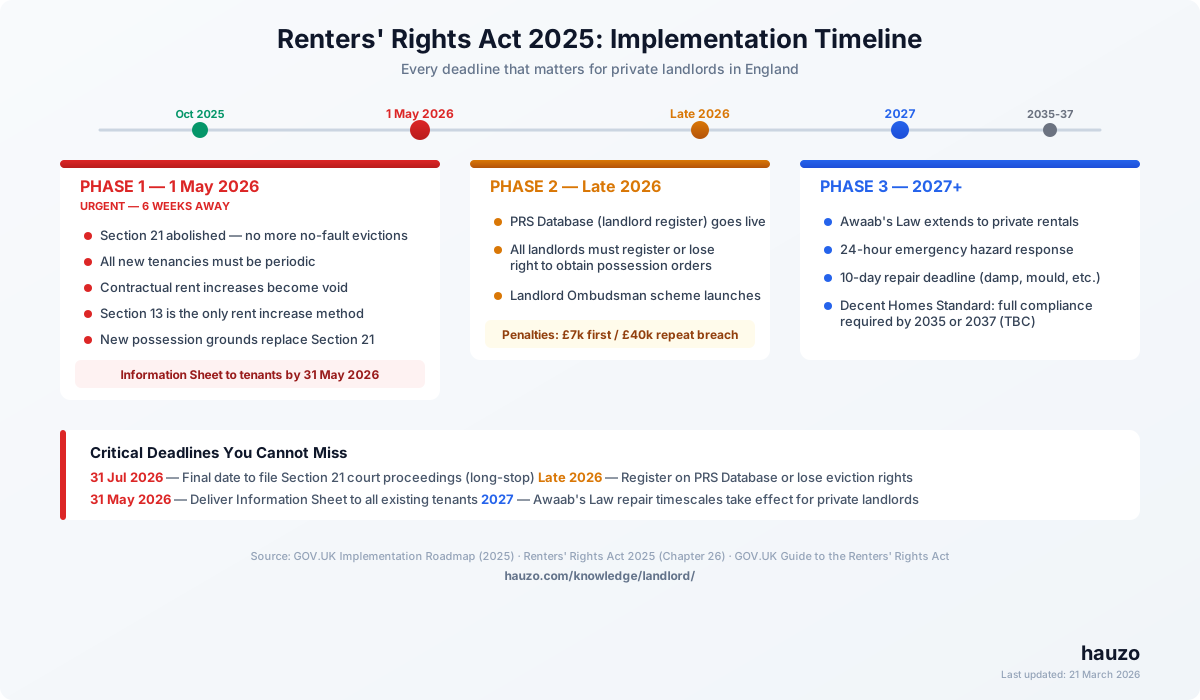
The Renters' Rights Act 2025 rolls out in three phases. Phase 1 hits on 1 May 2026 and contains the changes that affect most landlords immediately — Section 21 abolition, periodic tenancies, and the end of contractual rent increases. Phase 2 (late 2026) launches the PRS Database. Phase 3 (2027) extends Awaab's Law to private rentals.
Phase 1 — 1 May 2026: Section 21 abolition takes effect. No new Section 21 notices can be served after this date. All new tenancies must be periodic. Existing fixed-term tenancies that haven't expired convert to periodic tenancies. Contractual rent increase clauses become void — Section 13 is the only route. The new possession grounds under the revised Schedule 2 of the Housing Act 1988 replace Section 21 as the mechanism for regaining possession.
Phase 2 — Late 2026: The PRS Database (landlord register) goes live. All private landlords must register themselves and their properties. The Landlord Ombudsman scheme launches alongside it, though it becomes operationally mandatory from 2028.
Phase 3 — 2027: Awaab's Law extends to the private rented sector, imposing strict repair timescales for serious hazards (24-hour emergency response; 10 working days for significant issues like damp and mould). The Decent Homes Standard is confirmed for private rentals, with full compliance expected by 2035 or 2037 — the government hasn't published the final date.
| Phase | Date | Key Changes |
|---|---|---|
| Phase 1 | 1 May 2026 | Section 21 abolished; all tenancies become periodic; contractual rent escalation clauses void; new possession grounds take effect |
| Phase 1 (cont.) | 1 May 2026 | Tenants gain right to request fixed-term renewal; government publishes model tenancy agreement; notice period requirements change |
| Phase 2 (Early) | Summer 2026 (TBC) | PRS Database registration portal opens; deadline for initial registration (typically 6 months from portal opening) |
| Phase 2 (cont.) | Late 2026 | PRS Database goes live; mandatory registration deadline applies; Landlord Ombudsman scheme operational; property inspections begin |
| Phase 2 (cont.) | 2026–2027 | Landlord Ombudsman scheme becomes mandatory; tenants can lodge complaints; first enforcement actions for non-registration |
| Phase 3 (Early) | Early 2027 | Awaab's Law (24-hour emergency repair response) takes effect in private sector |
| Phase 3 (cont.) | 2027 (date TBC) | Decent Homes Standard becomes enforceable in private rented sector; inspections ramp up |
| Phase 3 (cont.) | 2035–2037 (TBC) | Full compliance deadline for Decent Homes Standard in all private rented properties |
| Ongoing | From 1 May 2026 | All rent increases must follow Section 13 procedure; no other route valid; disputes go to First-tier Tribunal |
| Ongoing | From 1 May 2026 | Right to evict is conditional on PRS Database registration; registration loss = loss of eviction rights |
Section 21 Abolition: What You Need to Know
Section 21 of the Housing Act 1988 has been a landlord's primary tool for regaining possession without having to prove breach or fault. "No-fault eviction" — serving two months' notice and regaining possession — ends on 1 May 2026.
What happens to existing Section 21 notices? Any Section 21 notice served before 1 May 2026 remains valid. If you have served valid notice before that date and the notice period has not yet expired, you can enforce it in court after 1 May 2026. But once 1 May 2026 arrives, the statutory ground ceases to exist. You cannot serve a new Section 21 notice on or after that date. The vast majority of landlords will need to transition to the new grounds for possession.
What replaces Section 21? The Act introduces eight new mandatory grounds for possession under the revised Schedule 2 of the Housing Act 1988. These grounds are split into two categories: mandatory grounds (where a court must grant an order if conditions are met) and discretionary grounds (where a court may grant an order). The key difference from Section 21 is that every ground requires you to prove something — either an intention to occupy, a mortgage requirement, or a breach by the tenant.
Source: Renters' Rights Act 2025, Schedule 2 (Housing Act 1988 amendments)
The New Possession Grounds: Your Toolkit After Section 21
The new grounds for possession replace Section 21 and are split into mandatory and discretionary categories. Knowing which ground applies to your situation is critical, because each has different notice periods, timescales, and evidence requirements.
Mandatory Grounds (Grounds 1–3)
Ground 1: Landlord or Family Occupation — You (or an immediate family member: spouse, adult child, grandchild, or parent) intend to occupy the property as your principal residence. You must give at least 2 months' notice and provide evidence of your intention. The notice must be served during the tenancy or on a date specified in the tenancy agreement. You cannot use this ground more frequently than once every 12 months for the same property, and you must genuinely intend occupation.
Ground 2: Mortgage Lender Requirement — The property is subject to a mortgage and the lender requires vacant possession. You must provide evidence from the lender and give at least 2 months' notice. This ground is less commonly used but is critical if you face repossession proceedings from your own lender.
Ground 3: Demolition or Significant Redevelopment — You intend to demolish the building or carry out works so substantial that the property will be uninhabitable. You must give at least 2 months' notice and have realistic plans in place. This ground requires court approval and evidence of the proposed works.
Mandatory Grounds (Grounds 4–8)
Ground 4: Breach of Tenant Obligation — The tenant has breached a core obligation of the tenancy (e.g., rent arrears, damaging the property, antisocial behaviour). You must serve a notice specifying the breach, give the tenant reasonable opportunity to remedy it (typically 14 days for rent arrears, 28 days for other breaches), and if not remedied, apply to court. The court has discretion but must grant an order if the breach is serious or persistent.
Ground 5: Antisocial Behaviour — The tenant, a person living with the tenant, or a visitor has engaged in serious antisocial behaviour affecting the property, neighbouring properties, or the neighbourhood. Examples include noise, harassment, violence, or criminal activity. You must provide evidence (police records, witness statements, council complaints) and give notice. The court has discretion but may order possession if the behaviour is serious.
Ground 6: Criminal Activity — The tenant, a person living with the tenant, or a visitor has been convicted of a serious crime (typically carrying a custodial sentence) or is subject to a Serious Crime Prevention Order. You must provide evidence of conviction and give notice. The court has discretion.
Ground 7: Abandoned Tenancy — The tenant has abandoned the property. You must serve a notice and provide evidence of abandonment (e.g., no contact for months, lack of occupation, utilities disconnected). This is a fact-based ground and requires careful documentation.
Ground 8: Rent Arrears — The tenant is in substantial arrears. The definition is typically "at least 8 weeks of rent unpaid" or "at least 2 months of rent unpaid," depending on whether rent is paid weekly, fortnightly, or monthly. You must serve a notice specifying the arrears and give the tenant at least 14 days to pay. If not paid, you can apply to court. The court has discretion but will typically order possession if arrears are serious.
Source: Renters' Rights Act 2025, Schedule 2 (Possession Grounds)
Tenancy Conversion and Periodic Tenancies
From 1 May 2026, all new tenancies are periodic unless specifically agreed in writing as fixed-term. Any existing fixed-term tenancy that has not ended by 1 May 2026 automatically converts to a periodic tenancy on that date.
A periodic tenancy is a tenancy that runs from month to month (or week to week) and continues indefinitely unless either party serves notice to end it. Once converted, the tenancy does not automatically revert to fixed-term.
What happens to my fixed-term tenancies? If you have a tenancy that ends before 1 May 2026, it follows its normal contractual end date and the tenant must leave or you can serve notice to end it. If the tenancy is still running on 1 May 2026, it automatically becomes periodic. You cannot prevent this by amending the contract or asking the tenant to agree — it is a statutory conversion.
What are the new periodic tenancy terms? Once converted, the periodic tenancy continues on the same terms as the fixed-term (rent, notice period, etc.), except that contractual rent increase clauses become void. All rent increases must follow the Section 13 statutory procedure. Notice periods for ending a periodic tenancy are set by statute: typically, either party can serve one month's notice to end a monthly periodic tenancy, though the contract may specify longer.
Can tenants request a fixed-term tenancy? Yes. From 1 May 2026, tenants have the right to request that a periodic tenancy be converted to a fixed-term. You can refuse (you are not obligated to agree), but if you do, the refusal must be reasonable. Courts will assess reasonableness case-by-case. If a dispute arises, the tenant can ask the First-tier Tribunal to determine whether your refusal was unreasonable.
Source: Renters' Rights Act 2025, Chapter 1 (Tenancy Conversion)
Rent Increases: Section 13 Is Now the Only Route
From 1 May 2026, any clause in a tenancy agreement that automatically increases rent (e.g., "rent rises by 5% on each anniversary") becomes void and unenforceable. The only legal way to increase rent is Section 13 of the Housing Act 1988, as amended.
Section 13 procedure is a statutory process: you serve a notice of increase (with correct legal wording and prescribed form), propose the new rent, and if the tenant objects, the First-tier Tribunal determines whether the proposed rent is reasonable based on comparable market rents. You cannot implement a rent increase without following this process.
What notice must I give? For periodic tenancies, you must typically give 3 months' notice for a rent increase (the exact period depends on how rent is paid, but 3 months is standard). The notice must be in the prescribed form (published by government). You cannot increase rent more than once every 12 months (except in limited circumstances, such as at the end of a fixed-term conversion).
What if the tenant objects? If the tenant disputes the proposed rent, they can refer it to the First-tier Tribunal. The tribunal then determines the "open market rent" — what a willing landlord and tenant would agree to for the property in the current market. This may be higher or lower than your proposal. The tribunal's decision is binding. You must accept it or end the tenancy (via a notice terminating the periodic tenancy or by using a relevant possession ground).
Can I still agree a higher rent with the tenant? Yes. If the tenant is willing to accept a higher rent voluntarily, you can do so. But you must follow the Section 13 procedure — the increase cannot be a condition of the tenancy continuing. Any threat to evict if the tenant doesn't accept a higher rent is potentially unlawful.
Source: Renters' Rights Act 2025, Section 6 (Rent Increases)
The PRS Database: Mandatory Registration and Loss of Eviction Rights
The Private Rented Sector (PRS) Database is a new register of all private landlords and their properties in England, launching in late 2026. Registration is mandatory, and failure to register means you cannot evict — even if a tenant breaks the law or stops paying rent.
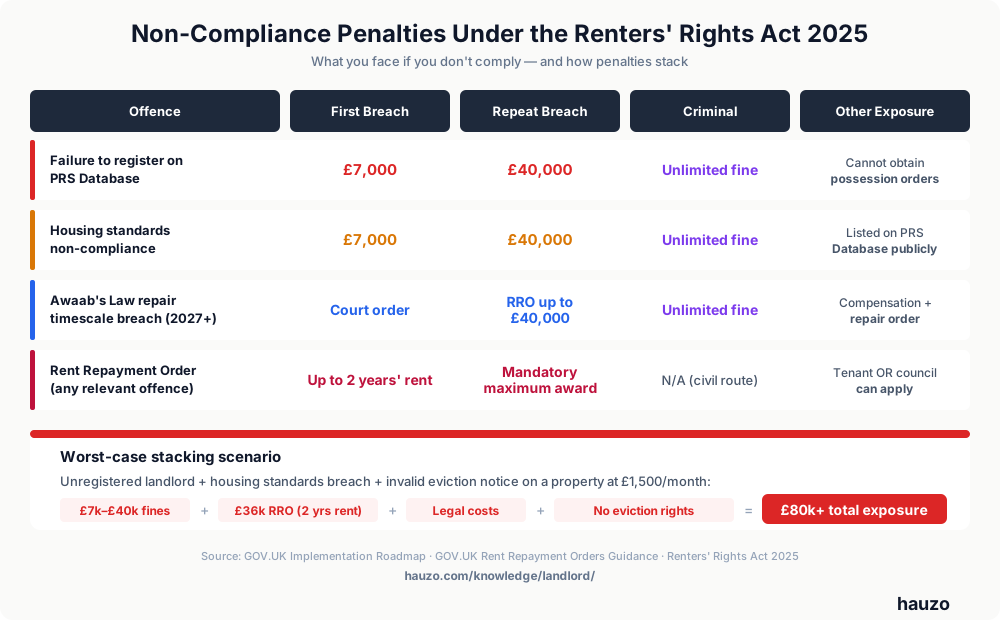
The PRS Database is a government-run register where all private landlords must list themselves and their properties. Registration is required to maintain the legal right to evict through court possession proceedings. Non-registration results in loss of eviction rights and potential fines up to £30,000 per property.
Who must register? All private landlords in England letting residential property must register, including: individual landlords, corporate bodies, institutional investors, non-UK residents, and landlords managing properties via agents. Social housing providers and registered providers are exempt.
What information must I provide? The database will require: your name and contact details (or your agent's details if you use one), the property address, the type of property, mortgage or loan details (if applicable), and evidence of compliance with certain standards (e.g., electrical safety certification, gas safety certification, deposit protection).
What is the registration deadline? The government has not yet published the exact deadline, but the typical pattern is: registration portal opens (expected summer 2026), with an initial deadline typically 6 months after opening. Expect a registration deadline in late 2026 or early 2027. Missing this deadline is high-risk — you immediately lose the right to evict.
What happens if I don't register? You cannot serve a valid possession notice or apply to court to evict. Even if a tenant owes 6 months of rent or commits serious breach, you cannot obtain a court order to regain possession. Your only remedy would be emergency action (e.g., injunctive relief), which is a much higher bar. The fine for non-registration can reach £30,000 per property. Registration is not optional.
Source: GOV.UK Implementation Roadmap (PRS Database)
Awaab's Law in the Private Rented Sector
Awaab's Law, named after Awaab Ishak (a child who died from exposure to damp and mould in a social housing property in Manchester), sets mandatory response times for serious hazards in rental properties. From 2027, the law extends to the private rented sector.
What counts as a serious hazard? Serious hazards include: damp and mould (from condensation or water ingress), electrical faults, gas safety issues, fire safety breaches, structural defects, lead paint, asbestos, and other conditions listed under the Housing Health and Safety Ratings System (HHSRS).
What are my obligations? You must respond to reports of serious hazards within strict timescales: 24 hours for emergency reports (immediate risk to health), 10 working days for significant hazards (serious but not emergency). "Respond" means acknowledging the report and beginning work to address it; "completed" means the repair or remediation is finished. Failure to meet these timescales triggers enforcement action and fines up to £30,000.
Can I claim inconvenience if the tenant forces me to repair quickly? No. Awaab's Law is mandatory. You must comply regardless of cost or inconvenience to you. The law prioritises tenant safety over landlord convenience.
What if I dispute whether it is a serious hazard? If you believe a reported issue does not constitute a serious hazard, you must still respond within the timescale. You can seek professional assessment (e.g., a surveyor's report), but you cannot ignore the report or delay action indefinitely. The enforcement body (typically the local authority) will assess the claim and issue an enforcement notice if necessary.
Source: GOV.UK Implementation Roadmap (Awaab's Law Extension)
The Decent Homes Standard for Private Rentals
For the first time in English law, the Decent Homes Standard is being applied to the private rented sector. This standard sets a national minimum for housing quality and is currently enforced in social housing. From 2027, private landlords must begin complying.
What is the Decent Homes Standard? A property meets the standard if it:
- Meets safety standards (electrical safety, fire safety, gas safety, lead safety, asbestos management).
- Has reasonably modern facilities and services (kitchen equipment, bathroom, heating, hot water, insulation).
- Is free from serious hazards (damp, mould, condensation, structural defects, pest infestation, hazardous substances).
- Is warm and has effective heating (room temperatures of at least 21°C in the main living area, 18°C in bedrooms).
When must I comply? The government has not published the exact deadline, but full compliance is expected by 2035 or 2037. Inspections are expected to begin from late 2026 or early 2027. You should begin assessing your properties now and budgeting for repairs.
What if my property doesn't currently meet the standard? You will be given time to remediate (likely a grace period of several years), but you must plan for potentially substantial costs: boiler replacement, insulation upgrades, damp treatment, rewiring, or even structural repairs. Starting now gives you time to spread costs and prioritise.
Source: GOV.UK Implementation Roadmap (Decent Homes Standard)
What You Must Do Before 1 May 2026
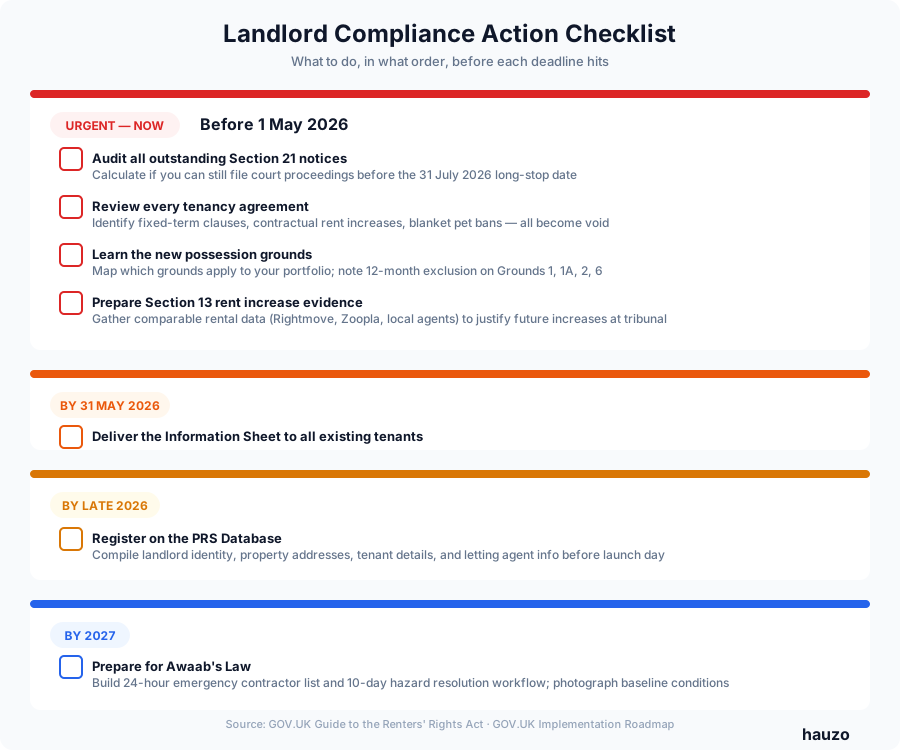
Compliance with the Renters' Rights Act is not optional. Here is what you must do now to prepare:
- Audit your existing tenancies: List all fixed-term tenancies and note their end dates. Any that expire before 1 May 2026 will end normally. Any still running on 1 May 2026 will convert to periodic automatically.
- Review your Section 21 notices: If you have served valid Section 21 notices, ensure you complete the possession process before 1 May 2026. Any notice served on or after that date is invalid.
- Stop using contractual rent escalation: Any clause that automatically increases rent becomes void on 1 May 2026. Prepare to use Section 13 procedure for all future increases.
- Prepare your new tenancy template: Draft a new periodic tenancy agreement that complies with the Act. Include the new prescribed information, remove automatic escalation clauses, and ensure all clauses are enforceable under the new law.
- Document your compliance: Gather evidence of electrical safety (EICR), gas safety (CP12), deposit protection, and other statutory requirements. These will be needed for PRS Database registration.
- Inspect your properties: Begin a detailed survey of each property to identify any breaches of the Decent Homes Standard, HHSRS hazards, or safety defects. Budget for repairs.
- Arrange insurance review: Speak to your landlord insurer to ensure your policy covers the new grounds for possession and any new liabilities under Awaab's Law.
- Plan for PRS Database registration: Once the portal opens, prepare your registration. Gather all required documents and ensure timely submission.
Source: GOV.UK Guide to the Renters' Rights Act
Frequently Asked Questions
Section 21 abolition becomes law on 1 May 2026. No new Section 21 notices can be served on or after this date. Any Section 21 notice served before 1 May 2026 remains valid and can be enforced, but from 1 May 2026 onwards, the statutory ground no longer exists.
Yes. Any fixed-term tenancy that has not come to an end by 1 May 2026 will automatically convert to a periodic tenancy on that date. You cannot prevent this conversion by amending the contract. New periodic terms (rent payment period, notice period) are set by statute unless the tenant agrees to a different arrangement.
The Act introduces new mandatory grounds for possession (Grounds 1–8) that replace Section 21. These include:
- Ground 1: Landlord or immediate family intends to occupy;
- Ground 2: Property subject to mortgage and lender requires vacant possession;
- Ground 3: Intention to demolish or significantly redevelop;
- Ground 4: Breach of tenant obligation;
- Ground 5: Serious antisocial behaviour;
- Ground 6: Criminal activity;
- Ground 7: Abandoned tenancy;
- Ground 8: Rent arrears.
Grounds 1–3 are "no-fault" but require notice and are only available under specific circumstances.
If you fail to register within the deadline, you lose the statutory right to evict via court possession proceedings. This means even if a tenant owes months of rent or breaches the agreement, you cannot enforce possession in court. The only exception is emergency protection (e.g., a court order for injunctive relief). Registration is mandatory and non-negotiable. The fine for non-registration can reach £30,000 per property in flagrant cases.
No. From 1 May 2026, any rent increase clause in the tenancy contract becomes void. Section 13 of the Housing Act 1988 (as amended) is now the only route for increasing rent. You must give statutory notice (typically 3 months for periodic tenancies), propose the new rent, and if the tenant objects, it goes to the First-tier Tribunal for determination. No automatic escalation is possible anymore.
Awaab's Law, named after Awaab Ishak (a child who died from exposure to mould in a council property), sets strict response times for serious hazards. From 2027, private landlords must respond to emergency reports within 24 hours and complete repairs within 7 days, and respond to non-emergency serious hazards within 10 working days. Failure to comply can result in enforcement action and fines up to £30,000.
The Decent Homes Standard is a national minimum for housing quality. It requires:
- All homes to meet safety standards;
- Reasonably modern facilities (kitchens, bathrooms);
- Effective insulation and heating;
- Freedom from serious hazards (damp, mould, electrical faults, etc.).
The government has not yet confirmed the final compliance deadline—it's expected to be 2035 or 2037. Regular inspections will begin from late 2026 or early 2027. Budget now for potentially significant repair costs.
You can manage tenancies yourself, but the Act imposes strict requirements on how all landlords (whether self-managing or using agents) must operate. These include:
- Proper tenant verification;
- Statutory prescribed information (prescribed particulars);
- Protection of deposits;
- Serving correct notices with proper legal language and timescales;
- Maintaining properties to the Decent Homes Standard.
If you use an agent, ensure they are registered on the PRS Database and understand the new legal framework. Self-managing landlords remain personally liable for all obligations, regardless of whether they delegate tasks to an agent.
Important: This guide was published on 21 March 2026 and reflects the current legal position. The Renters' Rights Act is being implemented in phases through 2027. Deadlines and regulations may be updated as the government publishes further guidance. Check GOV.UK regularly and consult a qualified lawyer if you are unsure about any aspect of the law.
Staying Compliant Throughout 2026 and 2027
The Renters' Rights Act is a complex, multi-phase implementation. Missed deadlines and misunderstood grounds can result in lost eviction rights, fines, and tenant claims. Hauzo's Landlord Compliance Navigator guides you through every requirement, checklist, and action step as deadlines approach.
Explore the Landlord Compliance Navigator