Section 21 Abolition: What Private Landlords Must Do Before 1 May 2026
Published: 21 March 2026
Last updated: 21 March 2026
Author: Hauzo
Jurisdiction: England only (Scotland, Wales, and Northern Ireland have separate tenancy legislation)
Section 21 is being abolished. From 1 May 2026, you cannot serve a no-fault eviction notice on any tenant in England. If you've already served one, you have a narrow window to act — and the hard deadline is 31 July 2026. This guide covers every transitional rule, every deadline, and what replaces Section 21 once it's gone. For a full overview of all changes under the Renters' Rights Act 2025 compliance guide, this is one of seven topics you need to master.
Source: Renters' Rights Act 2025; GOV.UK Implementation Roadmap
What Is Section 21 and Why Is It Being Abolished?
Section 21 is the provision in the Housing Act 1988 that let landlords end an Assured Shorthold Tenancy without giving any reason. You served two months' notice, applied to court, and the tenant had to leave — even if they'd paid every penny of rent and never caused a problem. Roughly 80% of landlord possession claims in England relied on it.
The government's position is that no-fault eviction is fundamentally unfair to tenants and drives housing insecurity. The Renters' Rights Act 2025 replaces Section 21 with a grounds-based system: you can still evict, but you need a legally recognised reason — and a court that agrees the reason is genuine. Start familiarising yourself with the replacement grounds now, before 1 May 2026.
Source: Renters' Rights Act 2025; GOV.UK Guide to the Renters' Rights Act
When Exactly Does Section 21 End?
Section 21 abolition takes effect on 1 May 2026. After that date, no new Section 21 notices can be served. Any notice served after 1 May 2026 is invalid — the court will not accept it, your tenant is not obliged to leave, and you've wasted time you could have spent using the correct process.
This is not a gradual phase-out. On 30 April 2026, you can serve a Section 21 notice. On 1 May 2026, you cannot. Mark 1 May 2026 in your calendar and work backwards from that date on any outstanding notices. The full timeline of all Renters' Rights Act 2025 deadlines is in our compliance timeline.
Source: GOV.UK Implementation Roadmap
Can I Still Serve a Section 21 Notice Before 1 May 2026?
Yes — but only if you can actually follow through. Serving a notice without filing court proceedings is pointless, because the notice expires and the long-stop deadline will cut you off. Before you serve anything, work backwards from 31 July 2026 to check whether you have enough time.
A Section 21 notice served before 1 May 2026 remains valid for its normal six-month window. But there's a ceiling: the Renters' Rights Act 2025 introduces a fixed long-stop date of 31 July 2026, after which no Section 21 court proceedings can be filed regardless of when you served the notice.
So if you serve a notice today, you have until the earlier of six months from service or 31 July 2026 to issue a possession claim at the County Court. Miss that deadline and the notice dies. You cannot revive it, extend it, or argue for an exception.
Make sure the notice itself is properly served — correct prescribed form, correct address, compliant delivery method. A defective notice is invalid from the start, and you won't discover the problem until the court rejects it.
Source: Renters' Rights Act 2025; Talbots Law
What Is the 31 July 2026 Long-Stop Deadline?
The 31 July 2026 long-stop deadline is the absolute final date on which a landlord can file court proceedings based on a Section 21 notice. After this date, Section 21 is permanently dead. There is no extension mechanism and no transitional relief. As Talbots Law's analysis of the transitional provisions confirms, the 31 July 2026 long-stop deadline is the hardest cut-off in the entire Renters' Rights Act 2025.
Here's how it works in practice. A Section 21 notice normally gives you six months to start court proceedings. But the long-stop overrides that:
- Notice served 1 December 2025 → normal six-month expiry is 1 June 2026 → proceedings must be filed by 1 June 2026 (before the long-stop)
- Notice served 1 March 2026 → normal six-month expiry is 1 September 2026 → long-stop overrides → proceedings must be filed by 31 July 2026
If you have any outstanding Section 21 notices, calculate your deadline now. If the deadline has already passed or is too tight for your solicitor to act, stop relying on Section 21 and switch to the new possession grounds.
Source: GOV.UK Implementation Roadmap; Talbots Law
What Does the Renters' Rights Act 2025 Replace Section 21 With?
The new possession grounds that replace Section 21 are set out in the revised Schedule 2 of the Housing Act 1988. Instead of one catch-all notice, you now choose from 37 specific grounds — each with its own notice period, evidence requirements, and court treatment.
Old vs New Eviction System — see infographic below
| Feature | Section 21 (Abolished 1 May 2026) | New Possession Grounds (From 1 May 2026) |
|---|---|---|
| Reason required | No — "no-fault" | Yes — must cite specific legal ground |
| Notice period | 2 months typical | 4 weeks (arrears, breach) or 4 months (sale, occupation, redevelopment) |
| 12-month exclusion | No | Yes — Grounds 1, 1A, 2, 6 cannot be used in first year |
| Court discretion | Minimal — mandatory | Significant — some grounds are discretionary |
| Tenant can defend | Very limited | Broad — tenant can contest reason, remedy breach, argue hardship |
| Eviction certainty | High | Medium — court must be satisfied; discretionary grounds allow refusal |
| Arrears threshold | N/A | 3 months (up from 2), with Universal Credit delays excluded |
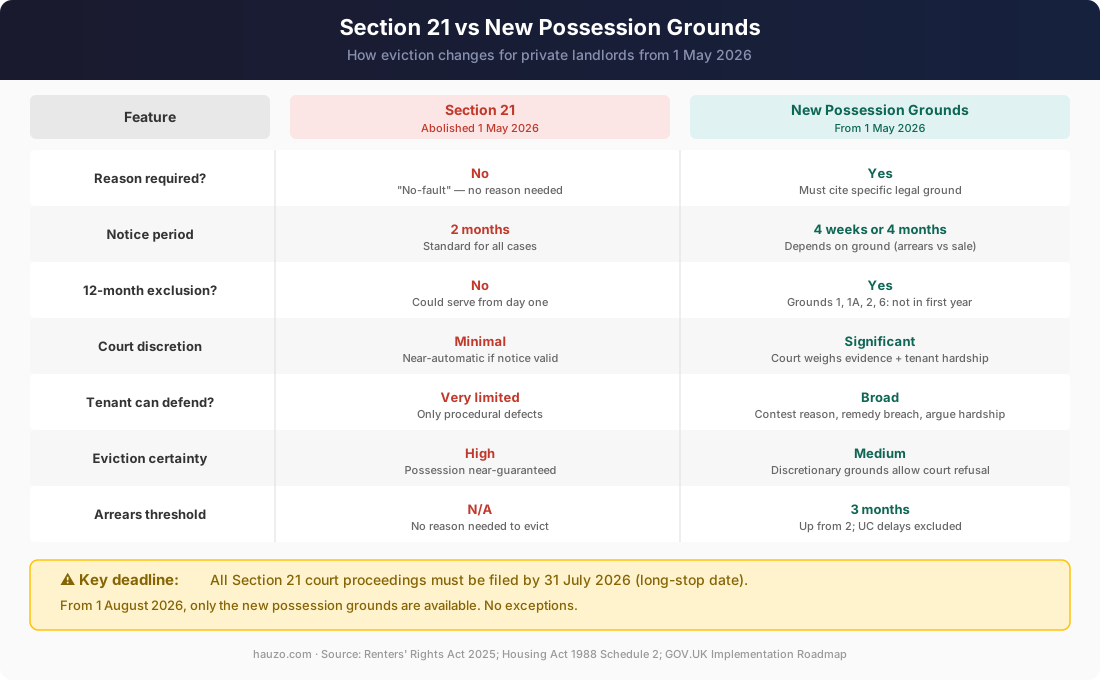
The grounds you'll use most often: Ground 1A (Sale) — four months' notice, for selling with vacant possession. Ground 1 (Occupation) — four months' notice, for moving in yourself. Ground 8 (Rent Arrears) — four weeks' notice, three months' arrears required. Ground 6 (Redevelopment) — four months' notice, planning permission required.
For rent arrears as a mandatory ground for possession, the threshold change from two months to three is significant — it gives tenants longer before you can act, and any Universal Credit payment delays are excluded from the calculation entirely.
Keystone Law's summary of the new grounds and notice periods is a useful cross-reference if you want the solicitor's perspective on how each ground works in practice.
Source: Housing Act 1988, Schedule 2; Keystone Law; GOV.UK Guide
How Does the Section 8 Process Compare to Section 21?
Section 8 replaces Section 21, but it is slower and demands real evidence — you need a specific legal ground, documentation to back it up, and a court willing to test both. Under Section 21, you served two months' notice and possession was near-automatic; under Section 8, the court examines your case properly. If you're using Ground 1A (sale), the judge checks whether you genuinely intend to sell — and can refuse if the ground looks like a workaround for no-fault abolition. Budget for more contested hearings and longer court waits than you're used to.
If you're currently managing a property and thinking about property standards your tenant can enforce if you delay eviction, remember that disrepair counterclaims are a common defence tactic in possession proceedings. Get your property compliant before you start the eviction process.
Source: Renters' Rights Act 2025; Lester Aldridge; The Barristers Practice
What If I Already Served a Section 21 Notice?
If you served a Section 21 notice before 1 May 2026, it's still valid — but only if you act within the deadline window. Calculate the earlier of (a) six months from your service date or (b) 31 July 2026. That's your hard deadline for filing court proceedings. If the deadline has passed, the notice is dead and you must use the new grounds.
Check three things immediately. Was the notice properly served (correct form, address, delivery method)? Has the notice period expired so you can actually file? And do you have enough time between now and the long-stop date to file and progress a court claim? If the answer to any of those is "no," stop relying on Section 21 and switch to the new grounds now.
For what happens to your tenancy after Section 21 — including how the automatic conversion to periodic tenancies interacts with outstanding notices — see our tenancy changes guide.
Source: Renters' Rights Act 2025; Talbots Law; Keystone Law
What Steps Should I Take Now to Prepare for Section 21 Abolition?
Section 21 abolition is six weeks away. If you haven't started preparing, treat this checklist as urgent. Every item here protects you from losing the ability to recover possession of your property — or from paying penalties for getting the process wrong.
Now — before 1 May 2026:
- Audit every outstanding Section 21 notice. List each notice, the date it was served, the notice period expiry date, and the court filing deadline (earlier of six months from service or 31 July 2026). If any deadline has already passed, mark the notice as dead and move on.
- Instruct your solicitor on any live notices. If you have a valid Section 21 notice with a viable deadline, file court proceedings immediately. Do not wait until June or July — court processing times mean delays can push you past the long-stop date.
- Learn the new possession grounds. If you're planning to sell (Ground 1A), note the twelve-month exclusion period and four-month notice requirement. If you have arrears cases, note the three-month threshold.
By 31 July 2026:
- File all remaining Section 21 court claims. This is the absolute final date. No exceptions.
Ongoing from 1 May 2026:
- Use Section 8 notices for all new evictions. Familiarise yourself with the prescribed form (MHCLG will publish it before 1 May 2026) and the evidence requirements.
- Register on the PRS Database when it launches. You must be registered on the PRS Database before applying for possession — without registration, the court will not hear your case.
Not sure which possession ground applies to your situation? The Landlord Compliance Navigator walks you through it step by step.
Source: GOV.UK Guide to the Renters' Rights Act; GOV.UK Implementation Roadmap
Frequently Asked Questions
Is Section 21 already abolished?
Not yet. Section 21 abolition takes effect on 1 May 2026. You can still serve a Section 21 notice before that date, but any court proceedings must be filed by 31 July 2026 (the long-stop deadline). After 1 May 2026, you must use the new Section 8 possession grounds instead. See our guide to the new possession grounds for a full comparison.
What happens if I serve a Section 21 notice after 1 May 2026?
It's invalid. The County Court will reject any possession claim based on a Section 21 notice served after 1 May 2026. Your tenant is not obliged to respond to it, and you'll need to restart the process using the new Section 8 grounds — losing months in the process. See When Exactly Does Section 21 End? above for the exact cut-off mechanics.
Can I evict a tenant without giving a reason after Section 21 goes?
No. From 1 May 2026, every eviction requires a specific legal ground under the revised Housing Act 1988 Schedule 2. The closest equivalent to Section 21 is Ground 1A (sale with vacant possession), but it requires four months' notice, genuine intent to sell, and cannot be used in the first twelve months of a tenancy. Our guide to the new possession grounds covers every available ground and notice period.
What if my tenant won't leave after the Section 21 notice expires?
You must apply to the County Court for a possession order. If the court grants it and the tenant still refuses to leave, you apply for a warrant of enforcement — a bailiff physically executes the eviction. You cannot change the locks, remove belongings, or cut off utilities. Illegal eviction is a criminal offence under the Protection from Eviction Act 1977. See What If I Already Served a Section 21 Notice? above for your next steps.
Do I need a solicitor to use the new Section 8 process?
Not legally, but practically it's advisable. Section 8 notices require you to specify which ground you're relying on, provide supporting evidence, and use the correct prescribed form. Errors in the notice invalidate it. If your case goes to a contested hearing, a solicitor significantly improves your chances — especially on discretionary grounds where the court weighs your case against the tenant's circumstances. See our Section 8 vs Section 21 comparison above for what to expect.
What penalty do I face for serving an invalid Section 21 notice?
The notice itself is simply void — the court won't act on it. But if you attempt to evict a tenant based on an invalid notice without a court order, you commit illegal eviction under the Protection from Eviction Act 1977 — a criminal offence carrying an unlimited fine and up to two years' imprisonment. The tenant can also claim damages for unlawful eviction through the civil courts. For the full penalty framework, see our Renters' Rights Act 2025 compliance guide.
Source: Renters' Rights Act 2025; GOV.UK Guide; Protection from Eviction Act 1977
This guide is maintained by Hauzo and updated within 48 hours of any GOV.UK, MHCLG, or Parliamentary change affecting Section 21 abolition and landlord possession rights. Last verified: 21 March 2026.
For personalised compliance tracking, deadline alerts, and step-by-step action plans, try the Landlord Compliance Navigator.